G Maps Extractor vs Apify - Choosing The Right Google Maps Scraper
Updated 8/24/2026
G Maps Extractor and Apify can both pull business data from Google Maps. But they are built for different people, and that is what the G Maps Extractor vs Apify choice really comes down to.
G Maps Extractor does one thing: it gets business data off Google Maps, through a no-code Online Scraper, an API, and a browser extension. Apify is bigger, a general scraping platform with tens of thousands of ready-made tools, called Actors, that scrape almost any site on the web. Google Maps is just one job among thousands.
So the question is not really which one scrapes Google Maps better. It is whether you want a focused tool or a flexible platform. Here is how to tell.
Quick Verdict
| Choose G Maps Extractor if | You mainly need Google Maps business data, fast, without configuring Actors or writing code. You get a no-code Online Scraper, a Google Maps Scraper API, and a browser extension on simple monthly plans. |
| Choose Apify if | You need to scrape more than Google Maps, want to configure or build your own tools, and are comfortable working in a developer-style platform. |
G Maps Extractor vs Apify: Feature Comparison
| Feature | G Maps Extractor | Apify |
|---|---|---|
| Main focus | Focused Google Maps business data | General web scraping platform with thousands of ready-made Actors |
| No-code options | Online Scraper (cloud) and a Chrome and Edge extension | Pre-built Actors you configure and run from a dashboard |
| Browser extension | Yes, works inside Google Maps | Not part of the workflow |
| API access | Google Maps Scraper API, plus Reviews and Photos APIs | Apify API and SDK across every Actor |
| Exports | CSV from the Online Scraper; JSON via the API | JSON, CSV, Excel, XML, HTML |
| Pricing model | Monthly plans with set record allowances, plus free monthly credits | Usage based, priced per Actor, with paid add-ons |
| Best user type | Google Maps leads, local SEO, sales, CRM | Developers and teams scraping many sites |
The split is clear: G Maps Extractor keeps things narrow and simple, while Apify offers far more range and asks for more setup in return.
What G Maps Extractor Is Best For
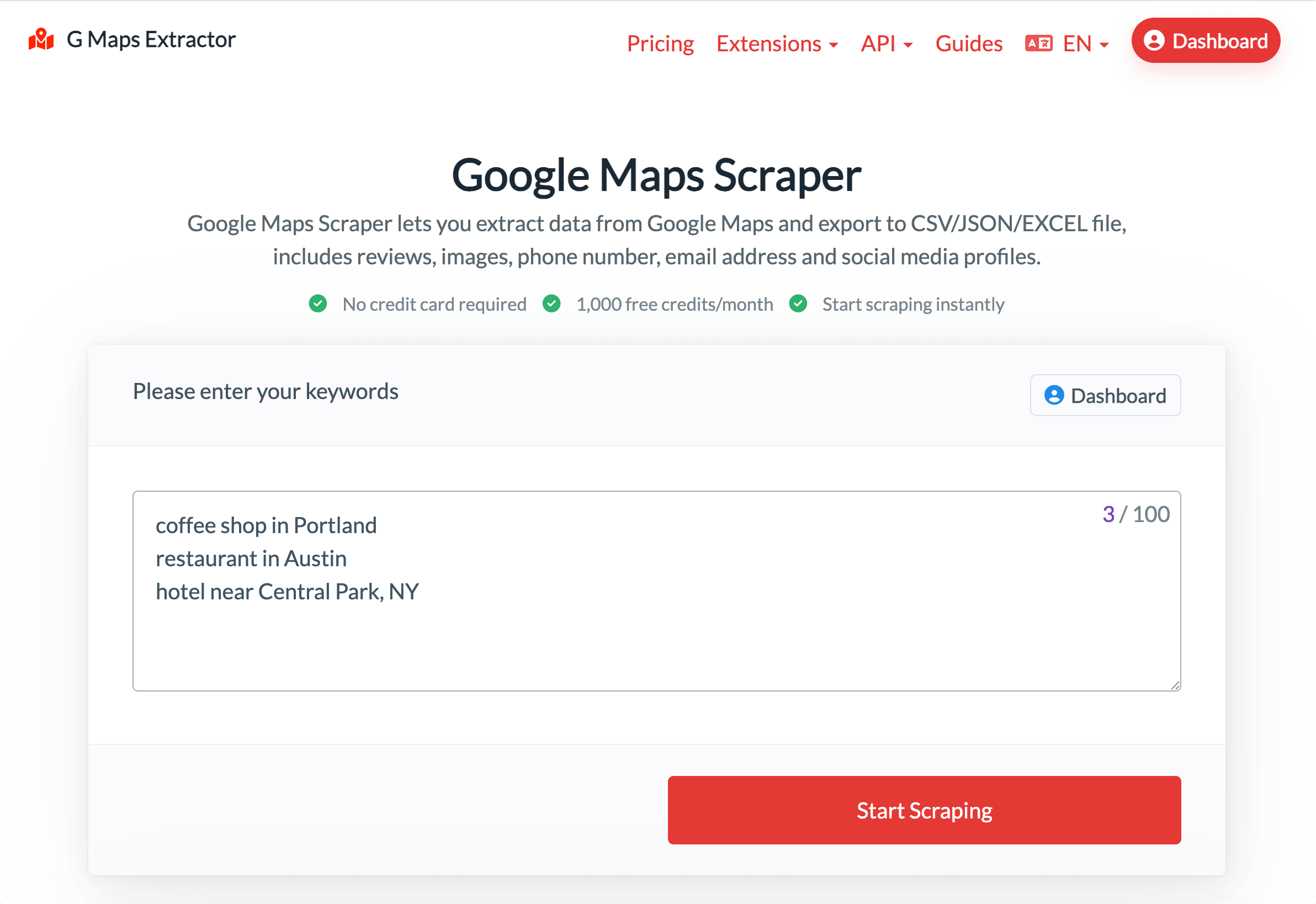
G Maps Extractor is for people who want Google Maps data without a learning curve, one clear end of the G Maps Extractor vs Apify spectrum. Its online Google Maps scraper runs in the cloud. It's a no-code Google Maps scraper: just type your keywords and location together—like "coffee shop in Portland"—run the job, and download a CSV. Nothing to install, and new accounts get free credits each month to try it first.
Need automation? The Google Maps Scraper API returns JSON for CRM enrichment and scheduled jobs, with separate Reviews and Photos endpoints. There is also a Chrome and Edge extension for pulling data while you browse Google Maps directly. One focused tool, three ways to use it.
If your work is local lead generation, sales, local SEO, or building CRM lists, and Google Maps is the source that matters, this is the faster tool to live with, with no Actor to pick or settings to tune.
What Apify Is Best For
_I2Fyo5ev3.png?updatedAt=1706334814284)
Apify is the better choice when Google Maps is only part of the job, and it sits at the other end of the G Maps Extractor vs Apify spectrum. It is a platform, not a single product. You browse a store of ready-made Actors, pick one, set it up, and run it. For Google Maps alone there are several Actors to choose from, built by different developers, each with its own settings and price.
That platform model brings real power. Apify supports advanced targeting like categories, coordinates, and custom map areas, plus contact details, lead data, and additional enrichment depending on the Actor you choose. It exports to many formats and connects to tools like Zapier, Make, and Slack, and developers can even build and publish their own Actors.
So if you scrape many different sites, want to customize how a scraper behaves, or have engineers who prefer an API and SDK, Apify is likely the better home. As an Apify Google Maps scraper alternative, a focused tool trades that flexibility for speed and simplicity, the right trade for some teams and not others.
Pricing: A Quick Comparison
| G Maps Extractor | Apify | |
|---|---|---|
| Free tier | 1,000 records per month | $5 monthly credit; actual usage depends on the Actor and pricing model |
| Paid entry | $29 a month for 80,000 records | Plans from $29 a month, plus pay as you go |
| Google Maps rate | Included in the monthly allowance | Pricing varies by Actor. Some Google Maps Actors may advertise around $2 to $4 per 1,000 places. |
| Model | Fixed monthly allowance | Prepaid credit plus pay as you go |
G Maps Extractor gives a fixed number of records each month, so the cost is set in advance and suits recurring lead generation. Apify starts with $5 of free credit, then charges as you go per Actor, which fits variable or one-off jobs.
Neither is always cheaper; it depends on your volume, how often you run, and which Actor you pick. Prices can change, so check the current G Maps Extractor pricing page and Apify's pricing page before deciding.
Which Tool Should You Choose?
A few plain situations settle most G Maps Extractor vs Apify questions:
- You just want Google Maps leads in a spreadsheet, with no setup: G Maps Extractor and its Online Scraper.
- You scrape many different websites, not only Google Maps: Apify.
- You want to automate Google Maps data in a simple way: the Google Maps Scraper API from G Maps Extractor.
- You need custom scraping logic, or want to build your own tool: Apify.
- You prefer a predictable monthly price: G Maps Extractor. You are fine with usage-based, per-Actor pricing: Apify.
If code is the sticking point, the guide on how to scrape Google Maps without Python shows the no-code path.
FAQ
Is G Maps Extractor a good Apify alternative?
If your focus is Google Maps, yes. In a straight G Maps Extractor vs Apify matchup, it is simpler and quicker to use for that one job. Apify is the stronger pick when you need to scrape more than Google Maps or want heavy customization.
What is the main difference between them?
Focus. G Maps Extractor is one product built for Google Maps. Apify is a general platform with thousands of Actors for many sites. Nearly every other difference in a G Maps Extractor vs Apify comparison follows from that.
Do I need to code or configure Actors?
Not with G Maps Extractor. The Online Scraper needs no code and no setup: enter keywords, run, download a CSV. On Apify you pick an Actor and configure its inputs, which suits more technical users.
Do both have an API?
Yes. G Maps Extractor offers the Google Maps Scraper API plus Reviews and Photos endpoints. Apify gives you an API and SDK that work across every Actor on the platform.
Which one is cheaper?
It depends on your volume, since the models differ. G Maps Extractor uses fixed monthly record allowances, while Apify charges per Actor as you use it. Compare each against your expected usage rather than a single price.
Conclusion
The G Maps Extractor vs Apify decision comes down to focus versus flexibility. If Google Maps is your main source and you want a simple, predictable, no-code workflow with an API when you need it, G Maps Extractor is the natural pick. If you need a broad platform to scrape many sites and build custom tools, Apify earns its place.
Both work with publicly available business information, and both beat doing this by hand. Match the tool to the job, and either can be the right call.
Try the online Google Maps scraper | View Google Maps Scraper API