Is Google Maps Scraping Legal GDPR and CCPA Guide for 2026
Updated 9/19/2026
This article is for general information only and is not legal advice. The rules can vary by country, the type of data involved, and how that data is used.
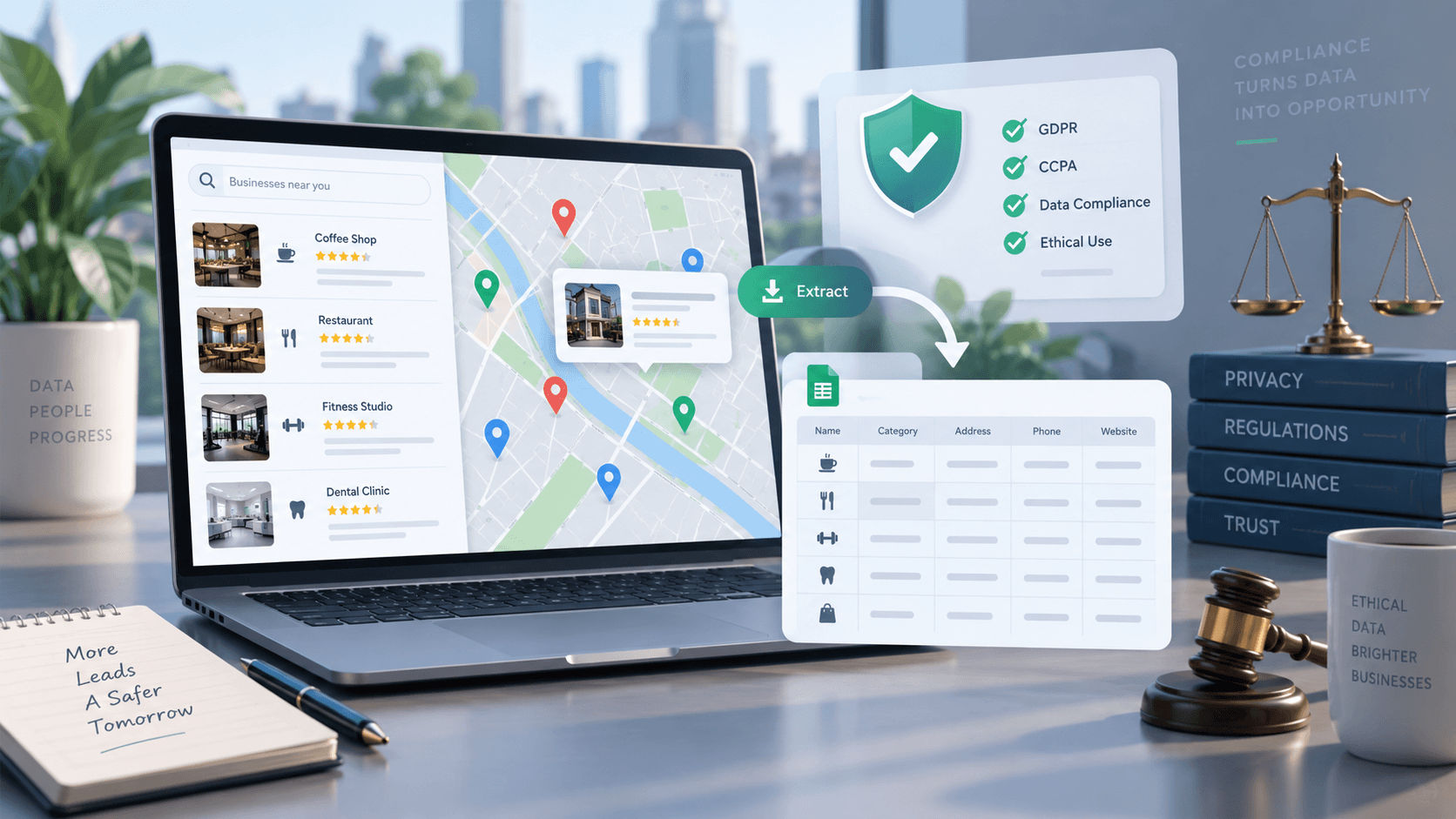
If you use Google Maps to build prospect lists or research local businesses, the legal question usually comes up sooner or later: is scraping Google Maps legal?
There is no single rule that covers every situation. Collecting information that is already visible to the public is not automatically illegal, but public access does not mean there are no limits on how that information can be collected or reused. In practice, it helps to separate three issues that are often mixed together: how the data is accessed, what Google’s own terms say, and whether privacy or marketing laws apply once the data is being used.
Is Scraping Google Maps Illegal?
Not by definition. There is a meaningful difference between reading information that any visitor can see and getting around passwords, account restrictions, paywalls, or other technical controls.
The type of data matters too. A restaurant name, category, address, and main phone number are very different from a named employee’s personal email address or private mobile number. One set of fields describes a business; the other may identify a natural person.
It is also worth separating the legal question from the contractual one. A particular use of Google Maps can raise issues under Google’s terms without necessarily amounting to a privacy-law or computer-access violation. That is why a useful compliance review looks at both the method of collection and what happens to the data afterwards.
What About Google’s Terms?
Google Maps has its own terms governing how Maps content may be accessed, copied, and reused. Those terms include restrictions on some forms of bulk downloading and reuse.
That is a contractual issue rather than a complete answer to whether collecting publicly accessible information is lawful. The terms can also change, so businesses that rely on automated data collection should check the current version instead of assuming that an older court case or blog post settles the question.
A ruling involving Facebook, LinkedIn, or another platform can still be relevant when thinking about public web scraping, but it does not determine what Google permits under its own terms.
What Meta v. Bright Data Actually Says
One case that comes up frequently in discussions about public scraping is Meta Platforms, Inc. v. Bright Data Ltd.
Bright Data collected publicly accessible information from Facebook and Instagram while logged out. In January 2024, the U.S. District Court for the Northern District of California granted summary judgment in Bright Data’s favor on Meta’s breach-of-contract claims.
The court found no evidence that Bright Data used its Facebook or Instagram accounts to carry out the scraping at issue, and it concluded that the relevant Meta terms did not prohibit the logged-out collection of publicly viewable data.
That makes the case useful, but only up to a point. It was about Meta’s terms and Bright Data’s specific method of accessing public pages. It did not create a general rule that any public website can be scraped without restriction, and it did not decide how Google’s current terms or privacy laws apply to a Google Maps workflow.
The narrower takeaway is more practical: courts may treat access to ordinary public pages differently from access that depends on an account or requires bypassing technical restrictions.
Source: Meta Platforms, Inc. v. Bright Data Ltd., U.S. District Court for the Northern District of California, January 23, 2024.
Does GDPR Apply to Google Maps Business Data?
Sometimes. GDPR applies to personal data relating to an identifiable natural person, so not every field in a Google Maps business listing will fall into that category.
A company name, opening hours, a general office address, or an address such as [email protected] may not identify a person at all. A sole trader’s name, a named employee’s work email, or a personal mobile number can be different because those details may point to a specific individual.
The fact that personal information is visible on a public page does not automatically take it outside GDPR. If personal data is involved, the organisation using it still needs a lawful basis for processing.
Legitimate Interests for B2B Prospecting
For some B2B prospecting workflows, organisations rely on legitimate interests under GDPR Article 6(1)(f). That can be a workable basis, but it needs more than a statement that the information was publicly available.
A typical Legitimate Interests Assessment looks at the purpose of the processing, whether the processing is genuinely needed for that purpose, and whether the organisation’s interest is outweighed by the rights and expectations of the individual.
For example, identifying local businesses that may be relevant prospects for a specific B2B product is a more concrete purpose than collecting contact information simply “for marketing.” The amount of data collected should also match that purpose. If a company name, website, category, and office phone number are enough, there may be little reason to collect additional personal details.
Context matters most in the balancing part of the assessment. A public office number listed for enquiries is not the same as a personal mobile number belonging to a named employee, even if both can be found online.
If legitimate interests are being used as the lawful basis, it is sensible to document that reasoning in a Legitimate Interests Assessment rather than relying on a general statement about public data.
Source: GDPR Article 6.
Transparency Still Matters
When personal data comes from a public source rather than directly from the individual, GDPR Article 14 may require the organisation using it to explain where the information came from and what it is being used for.
For cold outreach, the first communication is often where this becomes relevant. The recipient should be able to understand who is contacting them, why they are being contacted, what information is being used, where it came from, and how they can object.
If someone objects to direct marketing, that request should be respected. In practice, keeping a suppression list is often more reliable than simply deleting the record, because otherwise the same person may be added again during a later data collection run.
Source: GDPR Article 14.
What About CCPA and CPRA?
California approaches publicly available information differently from GDPR. Under the CCPA/CPRA, certain information that meets the law’s definition of “publicly available” falls outside the definition of personal information.
That can include information from government records and information a business reasonably believes was lawfully made available to the general public by the consumer or through widely distributed media. It does not follow that every detail found on a public website automatically falls outside the CCPA.
The source of the information, who made it public, and whether it identifies a California consumer can all matter. CCPA also applies only to businesses that fall within its scope, so a Google Maps workflow should be reviewed in the context of the organisation actually using the data.
Source: California Civil Code §1798.140.
Practical Checklist for Google Maps Prospecting
A few operational habits make the compliance side of Google Maps prospecting much easier to manage:
- collect only the fields you actually need for the business purpose;
- distinguish ordinary company information from data about named individuals;
- document the lawful basis you rely on when personal data is involved;
- explain where contact information came from when transparency rules require it;
- keep opt-outs or objections on a suppression list;
- avoid retaining stale prospecting data indefinitely;
- do not treat public pages and restricted areas as the same thing; and
- check any separate rules that apply to email, SMS, or phone outreach in the markets you contact.
The main point is that compliance is shaped by the whole workflow, not just the original source of the data.
How G Maps Extractor Fits Into the Workflow
The software used to collect business information does not, by itself, decide whether a campaign is compliant. What matters is the data being collected, the way it is accessed, the reason for collecting it, and how it is used afterwards.
G Maps Extractor focuses on publicly visible business listing information such as business names, addresses, categories, opening hours, ratings, websites, and public contact details.
If you are new to the process, our guide to extracting data from Google Maps covers the basic workflow. There are also separate guides for extracting business emails, phone numbers, and addresses.
The browser extension can run extraction jobs locally in the user’s browser. Email and social enrichment, where available, uses information found on publicly accessible business websites and public pages.
Those product characteristics can help keep a workflow focused on business information, but the compliance assessment still depends on the user’s own purpose, market, and use of the data.
Frequently Asked Questions
Is scraping Google Maps legal?
It can be, but there is no blanket answer. The method of access, Google’s terms, the type of data being collected, and the way the data is used afterwards all affect the analysis.
Does GDPR prohibit scraping Google Maps?
GDPR does not contain a general prohibition on scraping public business information. It becomes relevant when the information identifies a natural person. At that point, a lawful basis and the other applicable GDPR requirements need to be considered.
Can I cold email leads collected from Google Maps?
Possibly. Collecting a contact and sending that contact a marketing message are separate activities, and different rules may apply to each. Depending on the market, GDPR, ePrivacy rules, PECR, CAN-SPAM, or local direct-marketing laws may also matter.
Does Meta v. Bright Data make public scraping legal?
Not on its own. The decision is useful because it dealt with logged-out access to publicly viewable information, but it was based on Meta’s own terms and the facts of that case. It should not be treated as a general licence to scrape any public website.
Conclusion
For most businesses, the practical question is not whether “scraping” as a category is legal or illegal. It is whether a particular workflow is defensible.
That means looking at what is being collected, how it is accessed, whether any of the fields identify a person, why the data is needed, and how it will be used once it has been exported. A prospecting workflow built around ordinary public business information is very different from one that gathers large amounts of personal data or bypasses access controls.
Keeping the collection focused, documenting the reason for using the data, and handling objections properly will usually do more for compliance than relying on broad claims about public data. Where personal data is being processed at scale or the legal position is unclear, a review by your own legal adviser or DPO is the sensible next step.